
Evolute Institute · Safety Hub · Curriculum
Evolute's Psilocybin Retreat Curriculum: Preparation, Immersion, and Integration
Why a psilocybin retreat curriculum runs twelve weeks instead of one weekend, and the session-by-session structure of preparation, immersion, and integration that makes up the EvoSHIFT program.
This page covers the structure and content of the EvoSHIFT legal and medically supervised psilocybin retreat in the Netherlands. Medical and psychiatric screening (which happens before Week 1) is covered on Psilocybin Retreat Admission & Screening. How the psilocybin dose is measured (on retreat day 2) is covered on Psilocybin Truffle Dosage.
A psilocybin retreat curriculum is the full sequence of preparation, ceremony, and integration sessions a participant moves through, not just the day of the psilocybin ceremony itself. At Evolute, this runs twelve weeks: three weeks of live group preparation, a four-day on-site immersion that includes the truffle ceremony, and two further months of structured integration. This page sets out why that structure exists, then the session-by-session content of each phase.
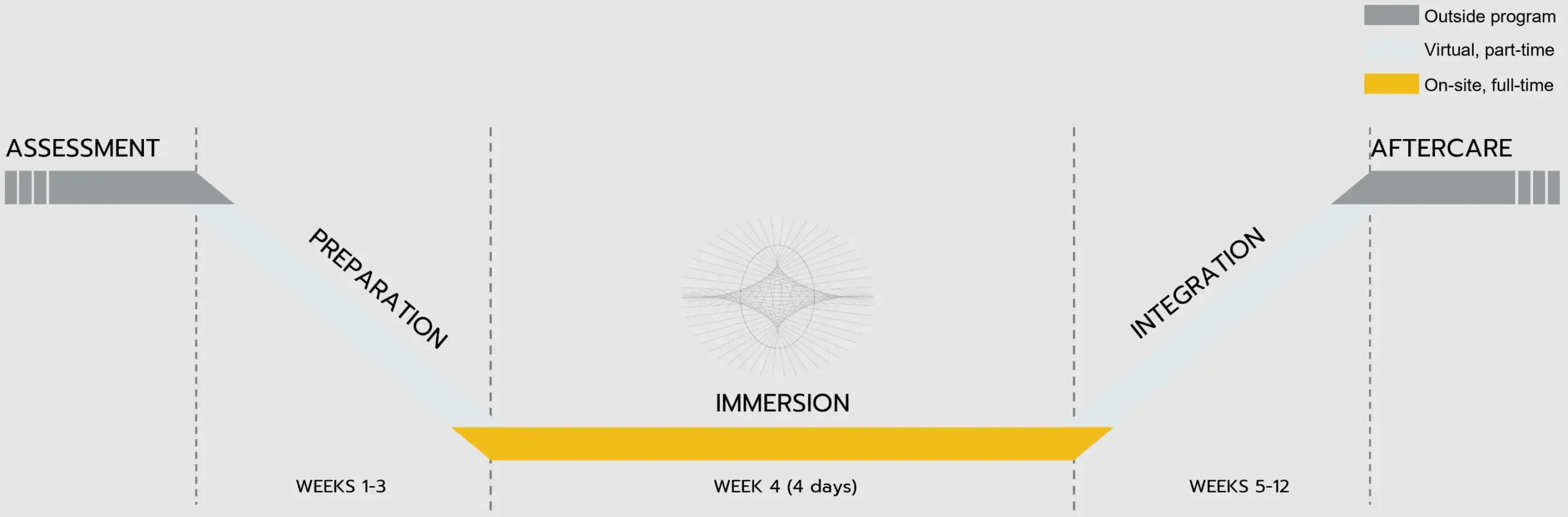
The EvoSHIFT psilocybin retreat curriculum: assessment before the program, three weeks of part-time virtual preparation, a four-day full-time on-site immersion in Week 4, part-time integration through Week 12, and aftercare beyond that.
Why a Curriculum, Not Just a Ceremony?
Psilocybin's effects are unusually dependent on the conditions around the dose, not the substance or dose alone. The concept of set and setting, psychological readiness and physical/social environment, was formalized as early as Leary, Litwin, and Metzner's 1963 study of how mindset shapes psilocybin outcomes, and more recent work confirms that psilocybin is "unusually sensitive to the psychological state" a person brings into the experience, with setting acting as "an active participant" in what unfolds rather than passive background (Carhart-Harris et al., 2018). A single-day or weekend-retreat with a single ceremony, taken in isolation, addresses neither of those conditions on its own - which is the reason the Evolute curriculum exists as a structured arc rather than a one-day event. A longer discussion of set and setting specifically is published separately at Set and Setting in Psilocybin Retreats.
Preparation builds the "set"
The three Weeks 1-3 preparation sessions exist to shape psychological readiness before anyone travels to the venue: intention, expectation, and the emotional state a participant brings in. This is the "set" half of set and setting, and it is worked on deliberately, in three 120-minute live group sessions and one individual caoching session, rather than left to chance on arrival day.
Facilitated immersion builds the "setting"
Setting is not just the physical room. Music has been described as a "hidden therapist" in psychedelic sessions, actively shaping emotional processing rather than sitting in the background (Kaelen et al., 2018), and a licensed physician's on-site presence throughout the ceremony is a recognized safety standard for this kind of work (Johnson, Richards, & Griffiths, 2008) - both of which are part of why the four-day Immersion phase is facilitated throughout, not simply a rented hotel room and a substance.
Integration determines whether it lasts
What happens after the ceremony may matter more than the ceremony itself for whether any insight becomes lasting change or whether the ceremony will simply be remembered as a "nice" trip. The quality of post-retreat integration practices is among the strongest predictors of durable positive outcomes following a psychedelic experience (Bathje, Majeski, & Kudowor, 2022) - which is why this curriculum runs three further 120-minute group integration sessions across Weeks 5, 8, and 12, and one individual session spaced over two months after the ceremony, rather than ending when the on-site retreat does. A longer discussion of the underlying neuroscience, including the neuroplasticity window this integration period may coincide with, is published separately at Your Brain on Psychedelics: Psychedelic Neuroscience.
Put together: a psilocybin ceremony without structured preparation and integration around it leaves the two variables research associates most closely with outcome, psychological set and post-experience integration, essentially unaddressed. That is the case for a curriculum, not just a ceremony. The evidence-graded standard Evolute's retreat approach is built against is published in the Psilocybin Retreat Evaluation Framework (PREF), specifically its domains on preparation, facilitator competence, and integration.
The Three Phases of the Psilocybin Retreat Curriculum, in Brief
- Preparation (Weeks 1-3, virtual, part-time): three live 120-minute group sessions and one personal coaching session over Zoom plus 4 hours of recorded content and an extensive reading list - intention-setting, the science of consciousness and altered states, and how personal development works.
- Immersion (Week 4, four days, on-site full-time): arrival, breathwork and life-story sharing, the psilocybin ceremony itself with 1:1 preparation beforehand and integration afterwards, a full day of debrief and integration work, and a closing day that translates the experience into everyday life.
- Integration (Weeks 5-12, virtual, part-time): three further live group sessions (Weeks 5, 8, and 12) plus individual coaching, spaced out over two further months so integration isn't rushed into the days immediately following the retreat.
Assessment (medical and psychiatric screening, covered on Psilocybin Retreat Admission & Screening) happens before Week 1, and aftercare continues beyond Week 12 for participants who want it. See EvoSHIFT Provider Self-Disclosure for more information.
The Full Psilocybin Retreat Curriculum, Session by Session
Browse each phase below, then open a session to see its full content - the same three phases described above, broken down week by week and day by day.
- Getting to know the facilitators, guides & each other
- Cultivating a beginner's mind
- The power of your Intention
- Guidelines for a safe journey
- Current scientific understanding of the mind and consciousness
- Current scientific understanding of altered states of consciousness and their effects
- The importance of set & setting
- What is vertical development and why is it necessary?
- Features of and conditions for personal development and integration
- Your life story and its role
- Arrival & check-in at retreat center
- Welcome & Intention sharing
- Life story sharing
- Resistance & Acceptance
- Breathwork
- Meditation & wisdom
- Meditation & movement
- Mindsets and inner capacity growth
- Connection exercises
- Values work & journaling
- 1-on-1 preparation sessions
- Ceremony with support for your psilocybin-containing truffles experience in a safe, legal and attuned group setting
- Meditation & movement
- Ceremony debrief and sharing
- Reflection & journalling
- 1-on-1 integration sessions
- Mindsets revisited
- Group exercises (embodiment & movement, nature walk, working with tensions & paradoxes)
- Fire Ceremony
- Meditation & movement
- Synthesising framework - Bringing it all together
- Transfer to every-day life
- Values & committed action
- Appreciation & closing circle
- Connecting with the group
- Integrating the experience back into everyday life
- Values & vision work continued
- 1-on-1 Coaching session
- Connecting with the group
- Zooming in on values-based & committed action
- Integrating the experiences back into your work life
- Update with give & receive groups
- 1-on-1 Coaching session
- Connecting with the group
- Sharing your insights & lessons about yourself & how you show up in the world
- Give & receive
- Commitment partnerships & peer-coaching circles
References
- Leary, T., Litwin, G.H., & Metzner, R. (1963). Reactions to psilocybin administered in a supportive environment. Journal of Nervous and Mental Disease, 137(6), 561-573. The first systematic study of how mindset (set) shapes psilocybin outcomes.
- Carhart-Harris, R.L. et al. (2018). Psychedelics and the essential importance of context. Journal of Psychopharmacology, 32(7), 725-731. https://doi.org/10.1177/0269881118754710
- Kaelen, M. et al. (2018). The hidden therapist: Evidence for a central role of music in psychedelic therapy. Psychopharmacology, 235(2), 505-519. https://doi.org/10.1007/s00213-017-4820-5
- Johnson, M.W., Richards, W.A., & Griffiths, R.R. (2008). Human Hallucinogen Research: Guidelines for Safety. Journal of Psychopharmacology, 22(6), 603-620. https://doi.org/10.1177/0269881108093587
- Bathje, G.J., Majeski, E., & Kudowor, M. (2022). Psychedelic integration: An analysis of the concept and its practice. Frontiers in Psychology, 13, 824077. https://doi.org/10.3389/fpsyg.2022.824077
All five citations are already used elsewhere in the safety hub (the Psilocybin Retreat Evaluation Framework and/or Evolute's own Set and Setting in Psilocybin Retreats page), reused here rather than newly sourced.
Curious? Let's Have A Chat.
Book a free call with us, and let's discuss any questions or concerns you might have. We'll help you determine if this program aligns with your current needs and ensure you feel prepared and confident to embark on this transformative journey.
"We are here to be in service of your journey." - Dr. Dmitrij Achelrod · Co-Founder